Flexibility
Proteins are not rigid. Some regions barely move and others swing about, and which is which matters for what a protein does. One of ProTop's four goals was to predict that from the structure. That predictor was never built.
What we proposed
In 2023 we planned a deep-learning model that takes a protein structure and predicts the flexibility of each part. It would combine two ideas: a graph neural network, which treats the structure as a graph of residues and learns from their neighbourhoods, and persistent homology, a tool from topological data analysis that summarises the shape of a point cloud, here the atoms, at every scale at once. The figure from our proposal sketches the pipeline.
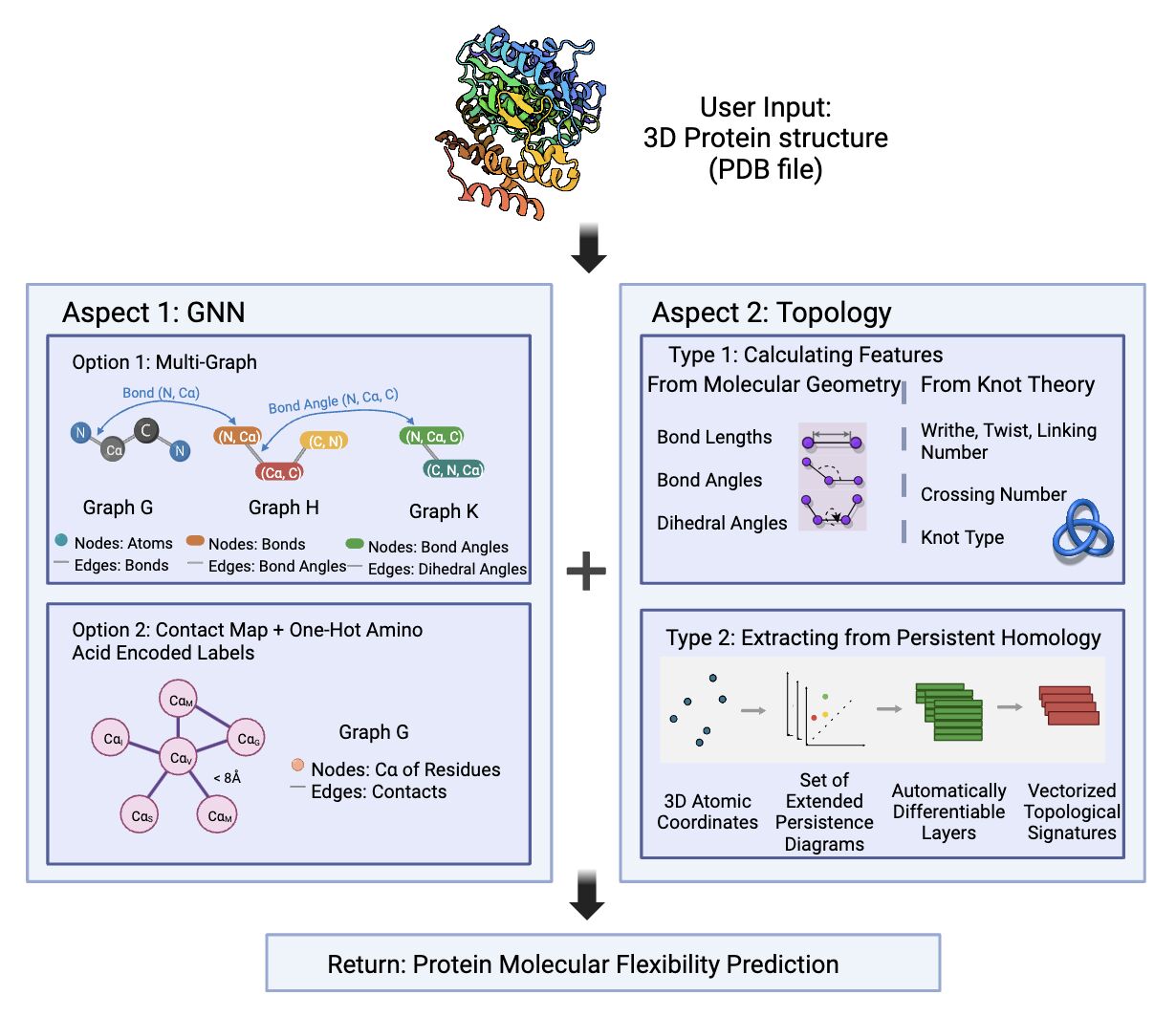
The upload form on the old page was a placeholder that said "to be enabled later this month". It never was, there was no trained model behind it, and this page does not have one either.
What does work today
Most structures determined by X-ray crystallography record, for every atom, a B-factor: how much the atom seems to smear around its average position in the experiment. A high value means the atom was mobile or poorly ordered, so it is an experimental view of flexibility, not a prediction. Any structure opened in the workspace can be coloured by it: tick Colour by B-factor under the 3D view.
A few cautions. B-factors depend on the crystal and the resolution, not only on the protein, so compare regions within one structure rather than across structures. NMR structures usually do not have them. And a model predicted by AlphaFold stores a per-residue confidence score in the same column, where a high value means "sure", the opposite of mobile.